
Find and Keep Your Confidence When Writing a Novel
Plus high-concept books and TONS of writing news and resources!

For writing links and resource, scroll down.
Latest episode of The Long Road to Publishing:
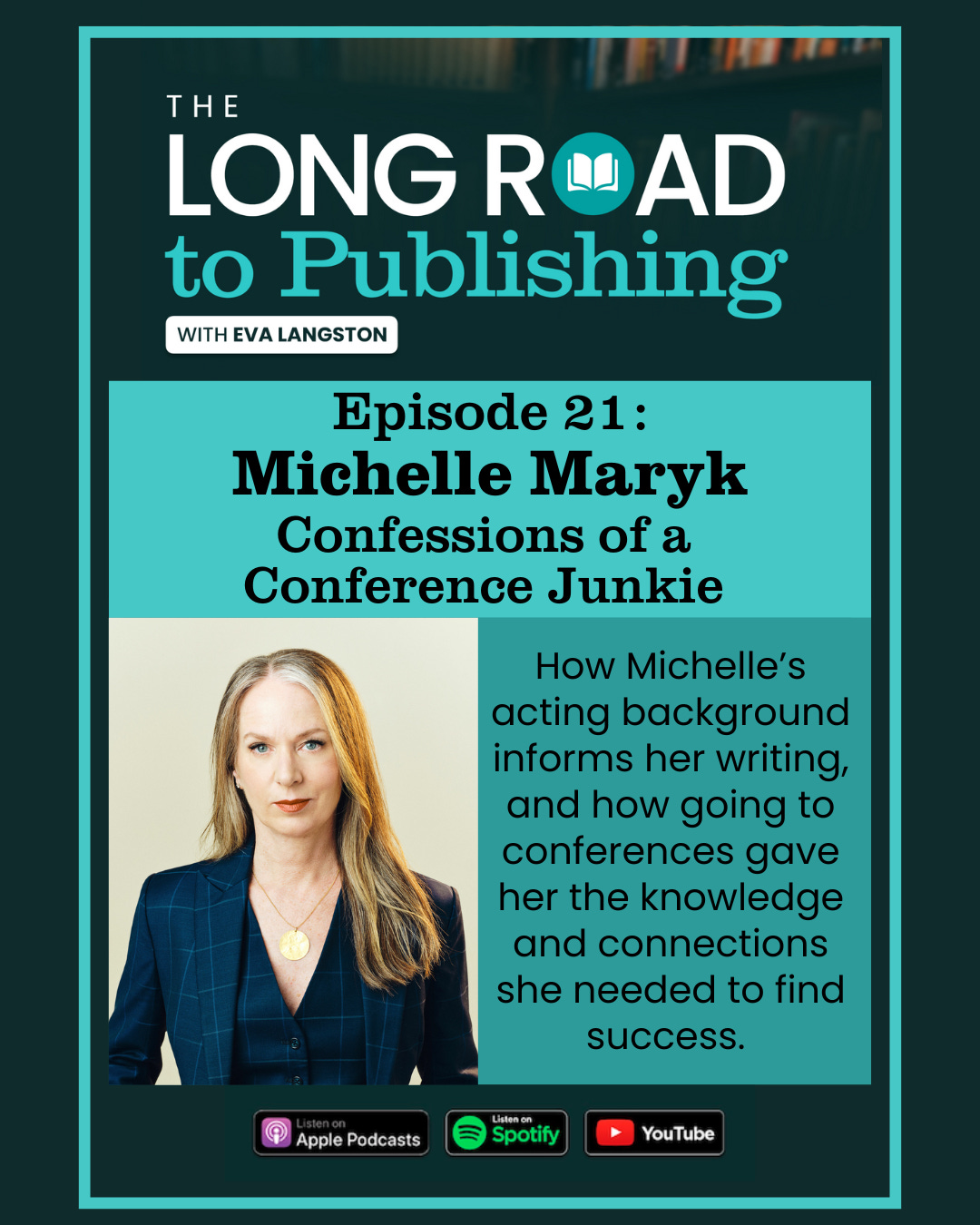
Episode 21: Confessions of a Conference Junkie with Michelle Maryk
Michelle Maryk has had a long career in acting and sketch-writing, and her incredible debut novel, The Found Object Society, was just released from Disney Hyperion.
Michelle and I discuss how her acting background informs her writing, how she got hooked on writing conferences, and, of course, her writing and publishing journey.
In this episode, Michelle talks about how her book is “high concept.” Curious to know what that means? Here’s an article I wrote about high concept YA books and how to write them. The examples are a bit dated now, but the info is still good!
“I have confidence in confidence alone!”
On The Long Road to Publishing we often discuss the dichotomy of being a writer working towards publication. You have to be confident enough to start down this difficult road, but you have to be humble enough navigate rejection and accept constructive criticism along the way.
But I want to put publishing aside for today and discuss confidence in the writing process itself. There are lots of people with ideas for novels who struggle to find the confidence to start writing in the first place. And then there are those who begin writing their novels but lose confidence when things get challenging. (Spoiler, in the drafting of any novel, there will come a point when it stops feeling quite so fun and easy.)

My top tips for finding and keeping your confidence while drafting a novel:
1. You don’t have to have it all figured out when you begin.
Some people plot out everything ahead of time with a 40-page outline like Ashley Winstead (this is how she described her writing process on a recent episode of The Prose Pros).
If that’s not you, no worries. (It’s definitely not me!) You can write a discovery draft. Instead of starting with a detailed outline, start with a few story touchstones. For example, you should know the inciting incident— what gets the story rolling. You should have some ideas about the midpoint and/or important plot points as well as a general sense of the climax you’re building towards. But that’s all you need. Now start writing and see what happens. Get to know your characters and their motivations and let them lead the way from Point A to Point B to Point C. It might be messy, but that’s okay. Entertain your craziest ideas. Have fun with it.
2. Writing something is better than writing nothing.
Sometimes you have to just get to the end, no matter how rocky the road, in order to get a complete story that can be shaped and improved. This might mean writing a scene you know will need to be changed or deleted. And that’s okay. Putting something down and moving on is better than not finishing at all.
Here’s an example: When I was writing the YA thriller that would get me my agent, I knew the climax would be when the protagonist confronts the killer and he locks her in his basement. I didn’t know how she was going to get out of the basement, but I thought, “I’ll figure that out when I get there,” and I started writing.
When I got to the climax, I came up with a way for her to escape, but my agent told me didn’t like that solution— could I come up with something else? So I dug deep and thought of a new idea, and it was much better.
Often our first ideas are not our best. But sometimes we have to put down that first idea so we can get to the end, look at the novel as a whole, and come up with something better.
3. Trust your creative brain.
Confidence comes from trusting yourself and, in this case, trusting your creative brain. Which can be scary at first, but once you see that it really works, it will give you confidence in future projects.
The example I gave in #2 is an example of trusting that I would come up with something when I got to the drafting of the climax.
Here’s how you DON’T come up with something: sit at your computer, stare at the blank page, and mutter, think, think, think.
Here’s how you DO come up with something: write a scene for your novel or write some dialogue between two characters. Play around, have fun, write something, even if you think it’s bad. Then go for a walk or a drive or do the dishes. Don’t listen to music or a podcast. Move your body and let your mind drift. You don’t even need to actively think about your book. But you will find (at least I do, and I know a lot of other writers do as well) that your brain is working on your story in the background, and that at some point in your walk or drive or dish-washing, an idea will come to you. Maybe you’ll hear a snippet of dialogue, maybe a scene will play out in your head, maybe you’ll suddenly have a solution for that plot hole. Sometimes it feels like it comes out of nowhere, but it’s coming from your own mind. How cool is that?
Pay attention to your dreams, too. Your brain might be working on your novel while you sleep.
The more you write, the more you realize that if you work on your novel regularly, your brain will start processing it in the background while you’re doing other things. You’ll come up with ideas that seem to have been handed down to you from the Muse herself. And the more this happens, the more confidence you will have, and the more you’ll trust your creative brain to come up with the ideas you need.
4. Trust the revision process.
Go ahead, write a messy first draft. Write a first draft with scenes that you know aren’t great. Don’t agonize over your line-level writing when you’re drafting. Don’t keep tinkering with the first few chapters so that you never write any new words. Move forward in your draft so you can get to the end. Know that you can always make things better (story-wise and prose-wise) in the revision process.
Know that it might take multiple revisions to get it right, and that’s normal.
Trusting the revision process gives you the confidence you need to write to the end, which might mean writing badly or entertaining crazy ideas. It’s all okay. The first draft is no place for perfection.
5. You can write even if you have doubts.
I’ve now written 12 complete novels (some are terrible, mind you, but the last few are pretty good). In the process of drafting every novel, there comes a time, usually in the middle, usually around 40,000 or 50,000 words, when I’m consumed with doubt: What am I doing? Where is this going? This is no good. This isn’t coming out the way I imagined.
It’s so tempting at that stage to give up. So tempting, perhaps, to start writing something new. But mid-way doubt and confusion is totally normal for almost every writer, and the only way out is through. I haven’t found a way to get rid of the doubt, but I try to ignore it and keep writing. I say to myself, “well, this might be bad, but let’s just keep writing anyway and get to the end.”
This is when you might need to take a lot of walks or drives or fold that big pile of laundry. This is when you might want to skip ahead and write scenes you’re excited about writing, or scenes you know need to be in the book.
This is when you might want to consult a craft book like Save the Cat Writes a Novel to help jump-start your brain and rev your story’s engine. But this is not the time to give up. You’ve already come so far. And, in my opinion, after you write the climax, you can consider yourself done with the draft. You can always write the resolution/wrap-up scenes during the revision process.
6. A word about the shiny new idea.
Often, when things get tough in the drafting process, writers start to think, “maybe it’d be easier to start something new.” They might get a new idea they want to pursue. They might even feel confident that this time, with this idea, it’ll be easier.
But remember, that new novel, at some point, will become an unruly, half-finished beast that fills you with doubt and confusion. My suggestion is this: you don’t have to ignore the new idea, but don’t abandon your work-in-progress. Write a little on your current project, then, by all means, play around with the new idea. Brainstorm, leave yourself a voice memo about it, write a scene or do a character study. But don’t think the grass is going to be greener with the new idea. Every book-length manuscript gets hard at some point. You’ll never finish writing a full manuscript if you’re always chasing the new idea.
7. Every author struggles.
Drafting a new novel is challenging. It’s gotten easier for me with years and years of practice, but there are still times when I can’t figure out a plot point, or I wrestle with self-doubt. Even bestselling and award-winning authors struggle. Listen to The Long Road to Publishing to hear successful authors like Julia Bartz and Karin Gillespie say, “I felt like a failure.” We all feel that way sometimes, but we keep going.
Find a writing community, whether online or in person. Talk to other writers who are at the same stage as you or maybe one step ahead. It might help you find the confidence to keep going, knowing that you’re not alone in your struggles.
Writing News & Resources:
For All Writers:
Online workshop from The Author’s Guild: Tax Tips for Authors - Feb. 19.
History Through Fiction offers a free guided beta reader match-up program!
Check out these graduate-level online classes from MFA for All.
30+ Publications paying for art, poetry, speculative works, micro-fiction and more from Write, Period.
Dozens of fee-free and paying opportunities for writersfrom Erika Dreifus
Two new publishing scams (yikes!) from Nathan Bransford
Join Liz Alterman and the Mystery Writers of America - Midwest Chapter on February 19 at 8 p.m. for a free webinar: Taking the Self Publishing Path (After Traditional Publishing).
Find a writers group (online or in person) using the Poets&Writers searchable database!
Every week the London Writers’ Salon publishes a fresh creative writing prompt.
Everyone is free to submit up to 500 words, in any genre, on the prompt. They award the winner a cash prize (£50 / $65) and publish our top 3 favorite entries.
The Writer’s Center website is a GREAT resource for finding grants, fellowships, residencies & retreats, publishers, and literary journal opportunities.
Writing Workshops offers lots of online classes in fiction, nonfiction, poetry, picture books, and the business of writing.
For KidLit Writers:
The Highlights Foundation offers tons of programs, workshops, and events for children’s writers and illustrators.
WriteMentor’s Novel & Picture Book Award application is open until March 31.
Literary Rambles has information on kidlit agents and agent interviews. Plus contests and giveaways.
Here’s an incredible list of upcoming events for KidLit writers!
Check out SCBWI (The Society for Children’s Book Writers and Illustrators) for events, conferences, critique partners and more. (Picture book through YA.)
For Querying Writers:
From The Forever Workshop: How Writers Get Agents in 2026 (What Actually Works) with publishing experts Jane Friedman, Karin Gillespie, and Erin C. Niumata
WriteMentor’s Novel & Picture Book Award application is open until March 31.
Follow Writing Day Workshops on BlueSky for New Agent Alerts with new agents actively seeking submissions!
Upcoming Pitch Events where you can pitch to agents and editors:
The Agent Summit online on March 26. Registration opens March 1 and critique slots do sell out.
The virtual Pitch-O-Rama event sponsored by the Women’s National Book Association on April 25.
Here’s a list of small publishers that do not require agents.
Here’s another list of small presses that accept manuscript submissions (no agent required).
Andrea Bartz has a list of successful query letters (including mine!).
Writing Conferences & Events:
The Writer’s Center in Bethesda: Publish Now! A One-Day Conference on Feb. 28.
The Writer’s Retreat at Good Contrivance Farm north of Baltimore is open year-round as an affordable writer’s retreat. Only requirement: that you use the time to work on writing. Spaces normally book about two months in advance.
History Through Fiction Conference with Colin Mustful in Beverly, MA: March 28-29
Thinking about going to a conference or applying for a residency? Check out the free searchable database on Poets & Writers.
The Writing Day Workshop “How to Get Published” Conferences are affordable and helpful. Plus, sign up for pitch sessions with agents. For online conferences, attend from anywhere in the world! Check out the upcoming conferences:
Texas Writing Workshop: March 6-7 (online)
Indiana Writing Workshop (Indianapolis): March 7 (in-person)
Writing Workshop of South Carolina (Charleston): March 7 (in person)
Carolina Writing Workshop (Charlotte): March 13 (in person)
Carolina Writing Workshop (Raleigh): March 14 (in person)
Kansas City Writing Workshop: March 14 (in person)
Writers Digest offers virtual conferences on a variety of publishing and writing craft topics.
The AWP Conference will be held in Baltimore, March 4-7, 2026.
For more writing conferences, check out this list or the free searchable database on Poets & Writers.
Alas... The first drafts of my first 3 novels practically wrote themselves. The 4th required some subconscious bubbling--as you describe--to come up with a satisfactory ending. The 5th is problematic. In 6 months I have not come up with a good ending that is either not trivial in itself or makes the first half of the story irrelevant. Someday maybe 😭